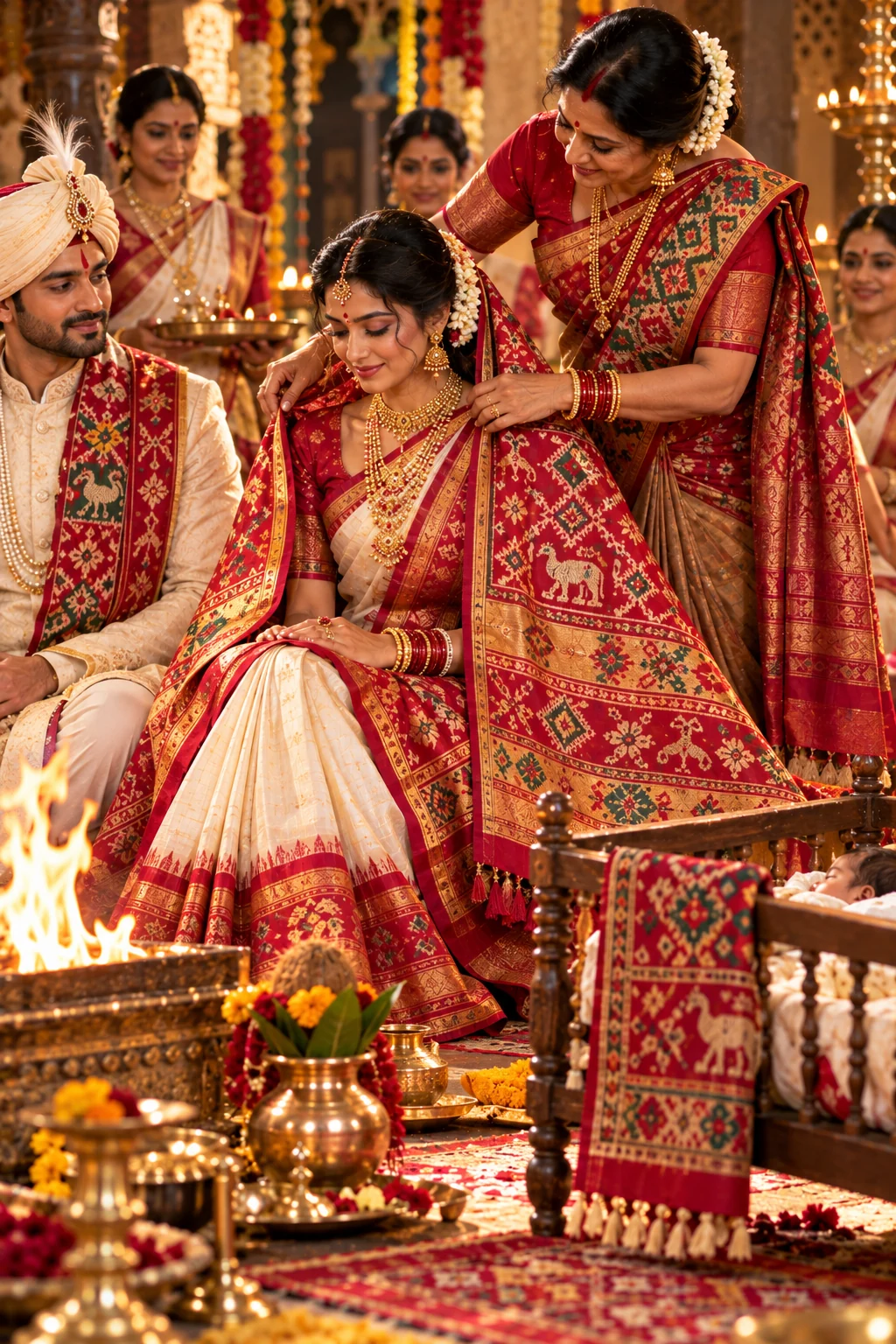
Not every heirloom is a saree. Some are worn over one.
West Bengal
Garad-Korial
C1
The Ritual Sari. Worn for the Goddess. Worn for the Fire.
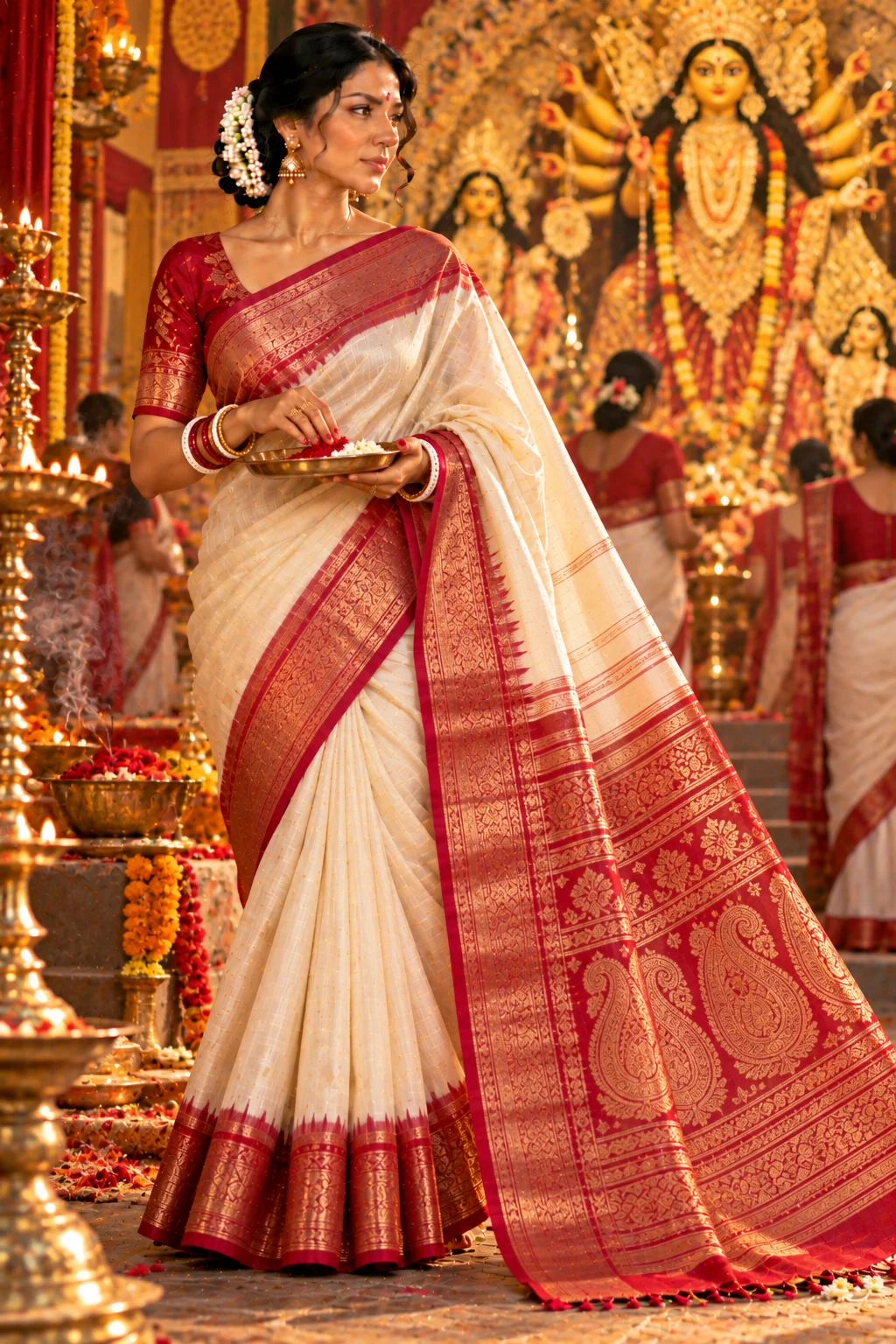
The Garad is not merely a saree. It is Bengal's ritual cloth — the white silk with the blood-red border that every Bengali woman wears when she stands before Durga, when she takes her wedding vows, when she smears sindoor on another woman's forehead during Sindoor Khela.
The Garad and its cousin, the Korial, are woven in Murshidabad from undyed tussar and mulberry silk. The white is the natural colour of the silk — no bleach, no dye. The red border is woven in, not printed. Together they carry a meaning that every Bengali understands without being told: white for purity, red for fertility, for auspiciousness, for the blood of life itself.
The Garad has a broader red border and striped pallu. The Korial is more dramatic — its border is khooni lal, blood red, richer and deeper. The Korial may carry intricate buti or floral motifs in the body; the Garad often does not.
During puja, the edges of a Garad or Korial are not stitched. No fall is attached. The saree remains kora — pure, in its original form, untouched by tailoring. This is not a practical choice. It is a spiritual one. The saree worn to approach the goddess must be as the loom made it.
The Garad and Korial come from the Jiaganj-Azimganj cluster in Murshidabad district. The weavers there are few, and they complain that the work is too much and the pay too little. A Korial takes weeks to weave. The fake versions — chiffon with red borders and sequins — are what most people see on screens and in markets. The real ones are quiet, heavy, and increasingly rare.
Zarbaft Edit: Murshidabad Garad Silk Sari with Red Border and Paisley Pallu
The Zarbaft Promise: Worn for the goddess. Worn for the fire. Woven to remain pure.
Gujarat
Patola — The Ritual Cloth
C2
The Auspicious Heirloom. Worn by the Mother. Protected by the Bridegroom. Never Discarded.
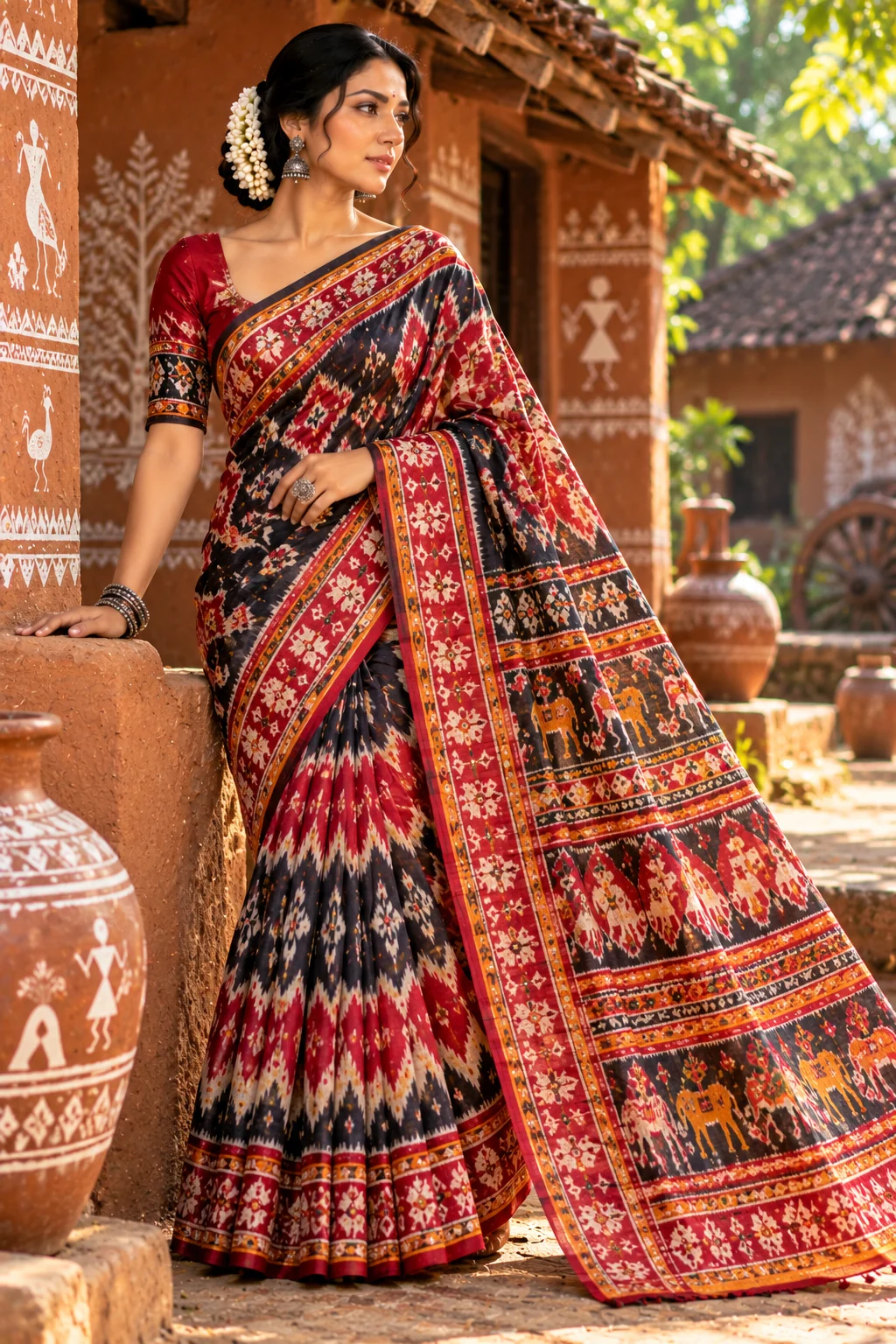
The Patola of Patan is already in the Zarbaft saree chapters. But it belongs here too — because the Patola is not only a saree. It is a ritual cloth, a protective object, a textile with power.
In Gujarati communities, the red Patola saree was traditionally worn by the bride's mother at the wedding ceremony — not the bride. The red Patola was considered too powerful for a young virgin who had not yet become a grihastani, a married woman. The bride wore the white or cream panetar — a simpler sari with red ikat only on the border and pallu. It was only after the marriage vows were complete, when she sat beside her husband before the sacred fire, that she was wrapped in the red Patola. The textile marked her transition from kanya to vadhu — from virgin to bride, from daughter to wife.
The Patola's power was not confined to the wedding. The bridegroom would wear a Patola as an upper garment as he journeyed to take his vows — it was at this stage that he was believed to be most vulnerable to evil influences. A Patola cloth was tucked under the saddle of his horse, so the horse would not be possessed by spirits and cause harm.
A Patola is never thrown away. When a Patola wears out, it is stitched into a quilt for wrapping a baby. Fragments are tucked into a cradle as a protective charm against dayans, witches who steal the life of unguarded infants. Even rags are washed, soaked in rose water, rolled into a wick, and burned in pure ghee with camphor — the resulting kohl is applied to babies' eyes so their vision will be pure, sharp, and farseeing.
In Kerala, the Patola was known as verali pattu and used by priests for the worship of the goddess Bhadrakali. It also covered the goddess's image when she was carried in procession to survey her domains and offer darshan.
Zarbaft Edit: Patan Patola Silk Sari in Deep Red with Traditional Motifs
The Zarbaft Promise: Not just worn. Carried. Protected. Passed down.
Mizoram
Puanchei
C3
The Mizo Identity. Wrapped Around the Waist. Passed Down Through Generations.
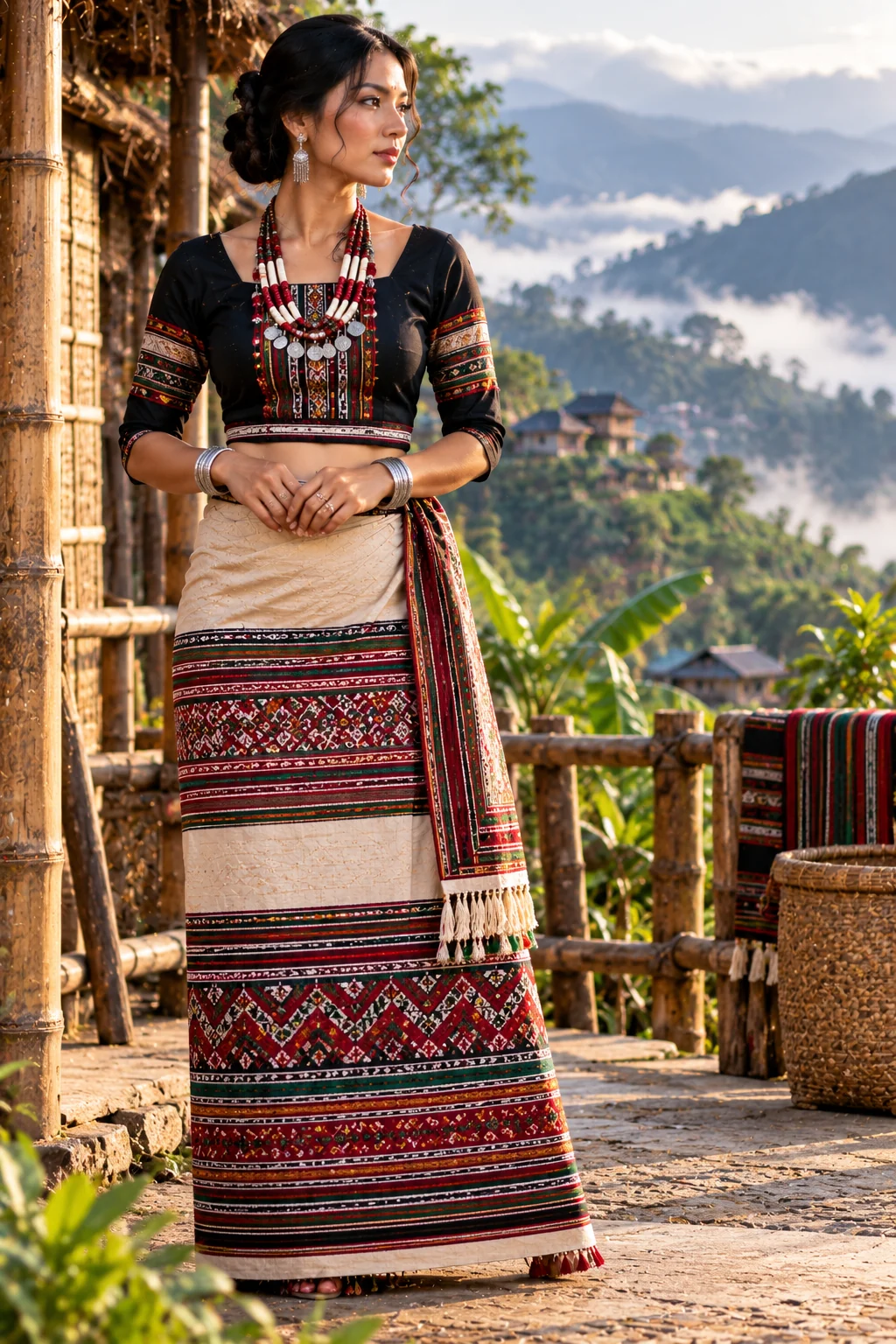
The Puanchei is not a saree. It is a shawl — a handwoven textile wrapped around the waist, tucked at the side, falling to the ankle. In Mizo, puan means cloth, chei means to decorate. It is the traditional costume of Mizo women, worn on weddings, festivals, and ceremonies.
Woven in three pieces lengthwise, with the middle panel the narrowest, the Puanchei is primarily cotton, though silk and synthetic versions exist. The earliest Puans were white. Over time, natural dyes brought colour. The motifs are drawn from nature, folklore, and tribal identity — flowers, animals, birds, geometric outlines. The Siniar motif, a traditional pattern of triangles, zigzags, and diamonds, appears in most weaves. The Sakri Zangzia — representative of the back of a tiger — is another signature.
The Puanchei is a symbol of Mizo identity and status. It is a prized possession, passed down through generations as a family heirloom. It is also given as a gift to honour guests and dignitaries. To receive a Puanchei is to receive respect.
Zarbaft Edit: Handwoven Mizo Puanchei Shawl with Siniar Motif
The Zarbaft Promise: Wrapped in identity. Woven in heritage.
Uttarakhand
Namawali Chadar
C4
The Name of God. Woven Into the Cloth. Worn on the Body.
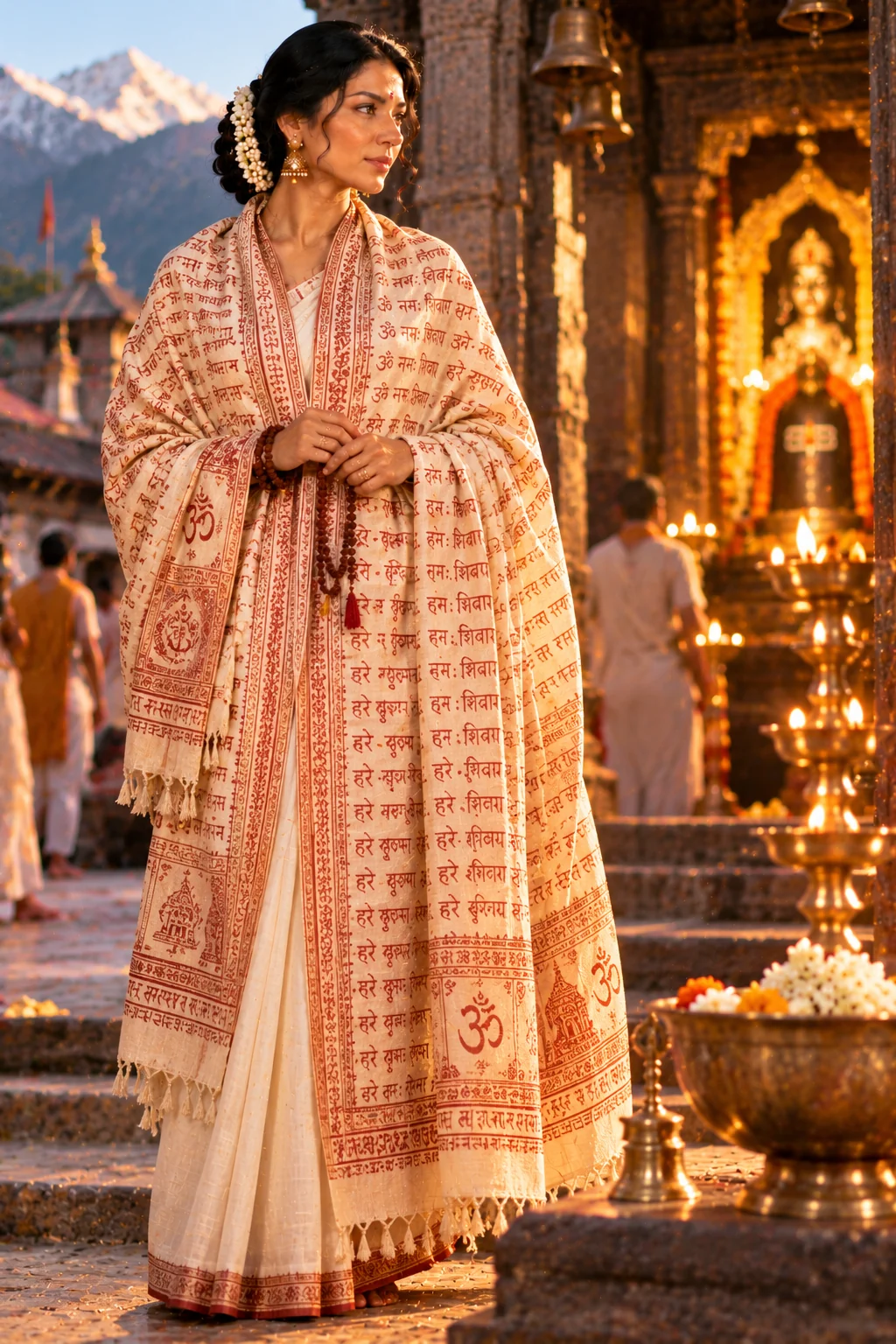
The Namawali Chadar is not a garment for beauty. It is a garment for remembrance. Printed, woven, painted, or embroidered with the name of a deity or a sacred chant, repeated across the fabric as a pattern, it is worn as a shawl, stole, or scarf — or used to cover the body during cremation.
The practice began around the fifteenth century with the Bhakti movement. Earliest versions were commissioned by royalty. Indian paintings from the eighteenth and nineteenth centuries depict widows wearing the Chadar during religious ceremonies. Once printing made production cheaper, it spread beyond royalty to priests and devotees.
Variations include the Hari-Nama Chadar, featuring the sixteen-word Hare Krishna mantra, and the Ramnami Ordhni, worn by the Ramnami sect of Varanasi, with the name of Ram repeated across the entire fabric.
The Namawali Chadar is believed to purify the soul. It is worn during religious ceremonies, used to drape altars and deities in temples, and placed over the body during cremation. It is not fashion. It is devotion, worn.
Zarbaft Edit: Hand-Printed Namawali Chadar with Devanagari Mantra Script
The Zarbaft Promise: The name of God, worn on the body.
Uttarakhand
Pichora / Rangwali
C5
The Veil That Makes a Marriage.
The Pichora — also called Rangwali — is not a saree. It is a ceremonial odhni, a veil of saffron-yellow cloth printed with red dots and sacred motifs, worn by married women across Kumaon and Garhwal on the most auspicious days of their lives.
Where a saree drapes the body, the Pichora crowns it. It is gifted to a bride at her wedding and worn over her saree — a bright, saffron layer that declares, without a word, that she is married, blessed, and protected.
The cloth is traditionally white or off-white, dyed a deep yellow by soaking in a solution of turmeric and water. While wet, women use a coin or gram seed wrapped in cloth, dipped in red dye, to stamp the surface with patterns. The center carries a swastika — the ancient symbol of auspiciousness — surrounded by the sun, moon, conch, and bell. The remaining surface is covered in a field of red dots. Once dried in the sun, gold or silver lace called kiran is stitched along the edges.
Yellow for prosperity and marital longevity. Red for love, fertility, and strength. The Pichora is worn during weddings, naming ceremonies, thread ceremonies, and festivals. It is also used to cover a married woman on her final journey — the veil that witnessed her marriage becomes the cloth that carries her from it.
It is for the married women of the family, and for the bride as she steps into that circle.
Zarbaft Edit: Hand-Printed Kumaoni Pichora in Saffron with Red Motifs
The Zarbaft Promise: Worn once. Worn for a lifetime.